Tuesday, June 19, 2012

Viejo San Juan

I can imagine the thoughts that ran through the minds of those who saw Puerto Rico and the San Juan Bay for the first time.  Verdant, a perfect natural harbor with high bluffs on one side, and close to abundant fresh water sources what more could a man in 1493 want. In less than 20 years there was a growing population in an established settlement high on those same bluffs.
Fast forward to today and when driving around the road signs direct you to old San Juan as Viejo San Juan. When you ask directions, or help that is how it is referred to. The second oldest settlement in the new world, it must have at the beginning looked very much like the homes left behind so far away across the Atlantic.
The homes of San Juan.
Homes in old San Juan are multi-colored and multi-level. All washed in the soft pastel shades of blue, green, yellow, peach, salmon, lavender and over all of everything else is white with black wrought iron, done simply with very little scroll work, very little flourishes. Most of the homes and businesses have the series double doors that are common to other settlements founded by the Spaniards. Balconies are Juliet style with very little room except to stand on them. Windows are large, covered in the jalousies that are common all over the Caribbean. A unique and simple system that allows light and air to flow in but keeps the hot sun and rain out. Most of the large homes are now either museums or have been split up into multiple residences many with businesses on the main floor.
Viejo San Juan is a walled city, most if its walls surviving the passage of time, the vacancies of the weather and the neglect of man. It is a city filled with plazas (squares), parques (parks), historia (history), Catedrals (cathedrals) and Capillas (chapels). Its street are paved with cobblestones, its sidewalks are now covered in tile, and its people are open, helpful and kind. I have had the pleasure of meeting several while here who spent their time and gave of their knowledge so that I could understand better and appreciate their city more.   
The walls surrounding Viejo San Juan and behind the wall
you can see the multi-colored buildings. 
Since San Juan was founded on the bay, its also one of the busiest ports in the Caribbean. Not just for cruise ships but for container ships, oil barges and many other kinds of shipping. As we drove through
 town we saw the marina filled with beautiful sailboats, large yachts, schooners, and smaller vessels. The day I took my walk down La Paseo De la Princessa there were fishermen in their boat out on the water bringing in their catch. A huge net filled with fresh fish, multicolored like the rainbow. I'm not sure what those fish were, but they were beautiful none the less.
The modern world has come to Viejo San Juan with a Starbucks, numerous shops, a CVS Pharmacy, souvenir shops, cigar sellers and street vendors galore. So in addition to seeing the historic places you can also eat a fine meal, shop till your credit cards are maxed out and then afterwards go to a cigar room choose your preference and smoke. The nightlife in San Juan and in old San Juan is alive and as the signs everywhere here point out, San Juan does it better. We saw numerous clubs, discos, bars and tapas restaurants. Bacardi is king here and so is the Mojito. There are numerous taxi stands located in strategic places in the walled city ready to whisk you back to your hotel. The piers are close by so you can ride the ferry across the bay to other hotels and condos to sleep off the effects of your night of partying and drinking Mojitos.
My new acquaintances told me of the local "moonshine" that is available. One has such a high alcohol content that it is illegal to be sold and I was warned not to try it as it can, if not made correctly be lethal. Another I was told tasted like fruit punch because it has a fruit base. It's sweet when you drink it cold but, you also don't feel its effects. Until you stand that is. Then you just simply fall face forward drunk as a skunk. I think I'll skip both thank you.
There are also casinos where you can while away your time. One is located in Viejo San Juan directly in front of Pier 2. It is a large building standing several stories high with every sort of gambling distraction that Vegas or Atlantic City has. So after eating, drinking, shopping, and smoking if you have any money left and want to try your luck at winning enough for a free vacation go on in and see if lady luck is on your side. Then again if you'd rather start at the casinos so you can win additional money for spending later, be their guest. They are open year round, holidays do not affect them.
A business on the ground floor and a
residence up above.

Multi-level home in old San Juan.

Such a dramatic entry for a home.


St. Anthony if I remember my catholic stuff right. This tile
mural was on the corner of a building in Viejo San Juan.

A view of the steep streets and the
cobblestones.

Moorish influences in old San Juan.
This door literally glowed, it had been
waxed and cared for so much.

I loved the pediment door frames on these doors.

One of the large mansions that has since been converted to
a government building. This is tourist center.

Another of the large mansions that has been converted. This
time into a school. I loved cutout in the facade of the building.

Another view of the wall. Most of the wall is still in place.

Another special school for students in San Juan. There are
ballet, art, and science schools that I saw in these
beautiful old mansions. 

A Plaza just for the tourists on the edge of old San Juan.

Believe it or not, the only time the chapels and churches
were open to was on Sunday. All the other days they were
chained and locked. I went by this chapel on Friday.
So no other picture but this one. 

Can you imagine living in this place.
With these wide steps starting at
your front. Beautiful.

The little house on the water's edge of old San Juan,
now part of a park or plaza.


The foundations of this structure are
actually built into the wall that
surrounds Viejo San Juan.

The only remaining gate for the city,
this was the gate that high officials,
members of nobility and high ranking
military officers would have used. 

This is the inside of the San Juan Gate. The picture shows
barrel vault of the passthrough and also shows the thickness
of the wall itself. Dan estimated the thickness to be about
10 feet.
A constant battle. The vegetation will take any foothold
it can get in the wall and that makes the wall crumble
that much quicker.


Some of the vegetation that grows on or near the wall, its
roots breaking down the walls slowly but surely. I'm
not sure what the little white things are on this plant.

Some kind of native fruit. Is it edible? I'm not sure.

This one was for me. I've always wanted to get a picture of
a spider web in the sun. Now I have, in Puerto Rico.

You can clearly see the wall's height in this shot. I was in awe
of something that was at least two stories high and 10 feet
thick that had been around for a few hundred years.

The original gate door for the San Juan gate was replaced
with this one and the date inscribed on it. 1749.

Looking down from the inside of the
city's walls.

I just had to get pictures of all these kids. They were playing
in the plaza fountain which is set up to shoot water on a
timer in alternating patterns. They would all disappear when the
water was not flowing but as soon as the water started up
they would run from all directions to play, laugh, scream
and jump while the water shot streams up in the air.

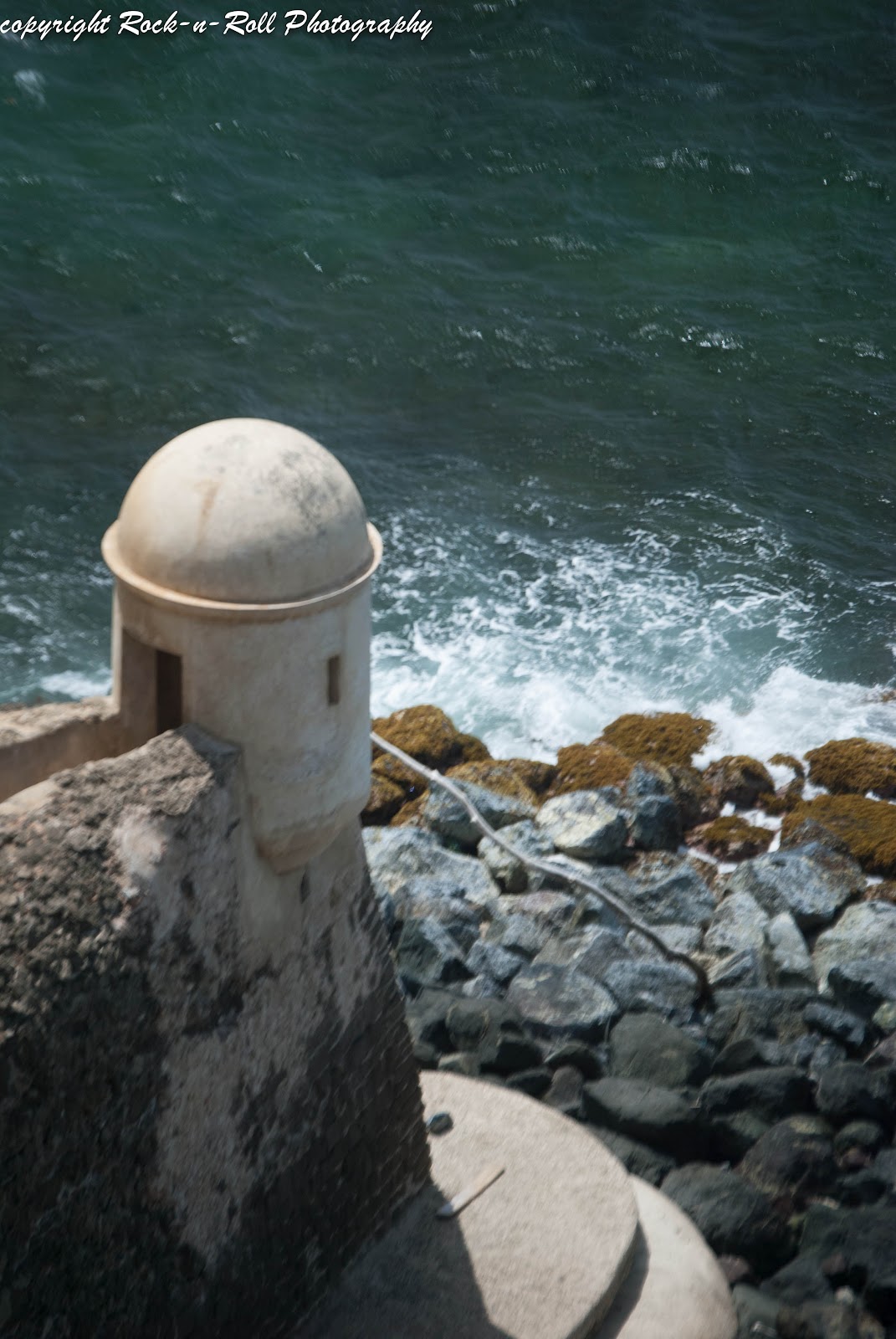
A sentry box in the walls of San Juan.
The old city is clean, has no unpleasant street odors, is free from beggars, small in size and for the most part has mostly pedestrian in traffic. Parking is available on the edges of old San Juan, but it is expensive. The trolleys run during the day and will take you to or close to shopping, restaurants, bars, and casinos. I only saw one hotel during our times in El Viejo San Juan, unlike other old cities we have visited like New Orleans. But the similarity between the two old cities can not be missed. They bear a striking resemblance to each other in many ways. One of the biggest differences is the lack of mosquitos here as opposed to New Orleans. The heat and humidity are similar, but the cool ocean breezes help to alleviate many a cranky tourists hotness.

Monday, June 18, 2012

Castillo San Cristobal

Do you remember that family of siblings in High School with the older brother who was so popular? He was the president of the class, captain of the football team, and homecoming king. He was the tallest, best looking and most broad shouldered of the bunch. And then there was his younger brother. Not quite as tall or broad shouldered, not quite as popular or good looking. If you can smile to yourself and think back to that family, then you will have a picture of Castillo San Cristobal and El Morro, as well as their even smaller sibling Fortin San Juan De la Cruz, located across the Bay of San Juan.

The second of the Historic National Sites named as such in 1949, that showed the military readiness of the island's defenses, is located about a half mile down from El Morro. Castillo San Cristobal is a smaller version of El Morro. Not quite as many levels, not nearly as large and positioned on the coast but further back from the entrance to the bay it was considered to be a part of the first line of defense by the Spaniards. But it was also used as a prison or jail for law breakers who lived in Viejo San Juan. One of the interesting things about San Cristobal when you visit it that a bomb shelter was added to the Fort during WWII by the U.S. Army. Since this Fort as well as El Morro were both used by the military during WWII, the army ensured that troops stationed there would have the latest and best protections possible against enemy attack. A phenomena that you will notice through out your tours of the Fortresses.
As military improvements became available the improvements became apparent in the Forts. Even though this is most noticeable in San Cristobal with the addition of the bomb shelter which is now used as a gift store and offices for the Park Service, as you walk through the Fort many of the other changes and additions that were made over a time span of about 250 years are pointed out with signage. 
One of the interesting features that we saw was the system of tunnels through out San Cristobal. The tunnels are at least six feet in height and width and allowed for troop movement unseen by the enemy. A big strategical advantage. I also noticed in San Cristobal that there were three wells inside the main plaza level that were the openings to very large underground cisterns. During the Forts building, the architect took into account the need for plenty of fresh water for those stationed there. We were told that the cistern/well system had a capacity of 780,000 gallons of fresh water. Much of that water was collected rainwater and in both San Cristobal and El Morro there is an elaborate system for collecting and then storing the water. Animals were not kept in San Cristobal so that the rain water would not be contaminated and there was a separate sewer system for the latrines that emptied directly out into the Bay. Fortunately, raw sewage being dumped directly out to the Bay no longer happens. 
This fort like the other had a chapel, smaller and with an open air design. It is set in a corner of the main plaza with the alter under roof, we were told that the troops would stand or sit out in the open air of the plaza as an enclosed seating area was not part of the original design. 
You can either visit El Morro first and take the free trolley to San Cristobal or start at San Cristobal and then move uphill to El Morro. The trolley runs continuously between the hours of 9 a.m. and 5 p.m. and most of the time seats are at a premium, especially on weekends. 
I would recommend seeing San Cristobal if time permits, if not just remember the younger brother and allow yourself the option to go check out other things in Viejo San Juan. If you do decide to visit the Fort, entry cost is $3 or if you have thought ahead (not me) and saved your receipt from your prior visit to El Morro then the fee is reduced to $2. This works the same at El Morro, if you visit San Cristobal first and save your receipt your entry cost is reduced. The park ranger at the entrance will hand you a large full color brochure at each location. You will really only need one. The same brochure applies to all the Forts in San Juan. Also as San Cristobal is a smaller fortress, you can allow a less time. Perhaps an hour to an hour and a half should be sufficient. 
If you care to take the trolley from San Cristobal the stop is across the street from the entrance to the Fortress and on the days we were in Old San Juan, there was a vendor selling bottled water for a $1 directly in front of the stop. There were also trash cans strategically positioned there as well. I tried to stay upwind of the trash can and was lucky enough to find a seat upwind while I waited for the trolley.


The walls of the fortress as viewed from
the outside.

This shows the Garita's placement on the outside seaward
walls of San Cristobal. The tops of the walls have breaks in
them for cannon placement.

This Garita or Sentry Box is one of the
oldest dating from the first construction
of the fort.

A view of Viejo San Juan from the ground defense level and
beyond the town to the Bay.

One of the main garrison buildings with numerous casements
or rooms that were used for the soldiers living quarters,
cooking, storage and offices. This was completely restored
in the 1970s using techniques from the time period and
similar lime mortar compounds as would have been used
originally. In that short time, it again shows its age and is in
need of help already. This is an ongoing battle as their were
restoration projects going on while I was there. At least 6
different areas were under restoration that I counted.

One of the tunnels of San Cristobal.

The chapel under roof. This is where
the alter is.

Long guns in storage for the soldiers use.

Barracks or quarters for the soldiers,
officers would have had their own rooms
or shared a room with another officer
depending on rank. Here the beds are
lined up on both walls, were a straight
wooden board underneath them and a
small wooden molding in place around
the sleeping board. It shows their
meager gear also. The stairs would have
been used for accessing the upper levels
if there had been a call to arms.

One of the wells that covered and accessed
the cisterns underground.

Officers quarters with a rudimentary
transom for air circulation.

The original tiles in the officers
quarters. These were the only
original Spanish tiles that I saw
at either fortress.  And this was
all that was left.

Views of the Fort and the Sentry box. There were much fewer
Sentry boxes at San Cristobal than at El Morro.

This was an opening in the walls that allowed for sentry
duty and cannon. This is the view toward El Morro and
away from old San Juan.

The view toward old San Juan and away from El Morro.

This was called the Devil's station
because of its proximity to the sea and
rocky shore.

Sentry box which shows its age. It was
originally covered in a lime based mortar
which was white. The salt air, constant
winds and sun have taken their toll.

Part of the water collection system. Rain water run off
ran through a closed system that eventually led it all
underground to the large cisterns.

A plaque which commemorates the
designation as a National Historic
Site for San Cristobal.

Sunday, June 17, 2012

Attacked by a Cross

Yep, you saw right.  I was telling Danielle about it over the phone and I could hear her laughing as I recounted my sob story about my other accident. It wasn't enough that I had fallen and banged up one knee, I had to go whole hog and bang up the other knee. Leaving me looking like Dr. Frankenstein's creation when I walk. Making it difficult to climb up or down stairs.
So now that Danielle has heard about the other knee I'm going to let the cat out of the bag and tell the world. Might as well, start at the beginning of this saga. After my little tour of Viejo San Juan, the Paseos, and the Bay I headed to El Morro. But before going on my tour there I decided to stop and check out a cemetery that was just too beautiful to not look at and wander through.
Unlike the walled mournful cemeteries in New Orleans where many of the tombs are in disrepair, there is talk of voodoo, and ghost tours are given nightly I saw a a cemetery that was about as opposite as you could get. It was walled like most Spanish cemeteries are; but in stark contrast to the ones in New Orleans, this one was bright, white, apparently well maintained and overlooking the sea. It sits on a bluff next to the fortress and glistens in the sun. Most of the markers are in white marble, they are very elaborate and well maintained.  
The cemetery by the sea.
What can I say, but it drew me in. So in I went. And it was breathtaking, glittering white with a blue sea in the background and crystal blue sky above. I heard waves crashing against large boulders down at the bottom of the bluff, the grave markers many of which were large raised tombs were luxuriant configurations of saints. Some tombs had different poses of Jesus, others were decorated with angles, marble carved flowers, and the names were prominently displayed on all the tombs. Family names, not single individuals. And though most Spanish style cemeteries, and this dates from the Spanish occupation of Puerto Rico, have crypts in the wall there were no crypts in these walls. Or so I thought. But as I walked through the cemetery I did find walls crypts in the older part labeled Section 1.
The cross that attacked me.
However there was one little lonely cross in the new section that had only a few colored tiles decorating on the front of it. It was placed on the edge of the graveyard closest to the sea, leaning a little, with no name on it that I could see. I set my camera bag down on the ground and took my position to shoot, one knee down and one not. After my picture of the cross, I bent over to pick up my bag. As I picked up my bag, I had the strong desire to reach out my hand and touch the cross, curiosity wanting me to look for some inscription that would show a name, a date, something but no I just didn't feel comfortable touching it. I moved away to pick up myself and my things. Then that's when it happened. The cross broke free of it's base which was just under the soft, spongy grass and when it did it fell on my other knee. Taking me down with it. Here I was again down on the ground, the other knee wounded and feeling the pain of a very heavy cross having hit me.  
My first thought was "again!" But then I looked at the cross and knew my knee wasn't as important as that cross having fallen. I hobbled around the cemetery for a while to find the office of the cemetery. Once I found it I knocked on the door and went in. I told Dan that whoever was buried there wanted to get my attention. They did. I also told him with my luck it was probably someone who just didn't want their picture taken.
The next day my knees felt better and I was out again hobbling around, taking pictures, getting lost, asking directions and speaking to folks. 


St. Mary Magdalene cemetery in San Juan.

One of the first tombs that I came upon.

Straight ahead inside the front gate.

One of the tombs in section 3, the new section.

The waves crashing on the rocks of the beach below.

Another of the family tombs in Section 3.

Just a small square box with names on all sides.

The entrance to Section 1, the old section of the cemetery.

In the old part of the cemetery, the markers
are much smaller and simpler for the most
part. But there are a few that are quite
showy.

In the older section, this round mausoleum sits in the middle
of the field of tombs and markers.

Dated from 1878, the old part of the cemetery.

1886 in Section 1 of St. Mary Magdalene cemetery.

Gates of a tomb facing the sea.

In the old part of the cemetery, a low tomb.

A very weathered marker in Section 1.

Section 1, and behind this cross the long building is a
part of the wall that has tombs built into it unlike the
new section where there are not tombs in the wall.

With brass double doors.

Another that faces the sea and shows the
weathering effect of the salt breezes.

Leaving the old part of the cemetery.

Weathered copper on a tomb in the
old part of the cemetery.