Tuesday, June 5, 2012

Scandal!

Oakley Plantation
It was a simpler time, a time of grace and elegance, what was called genteel society. A time nevertheless of rules, spoken and unspoken. And being born into wealth brought with it duty and responsibility. A time of limits and proper behavior. It was the time when southern plantation owners and their families lived a life that didn't exist before and hasn't existed since.
A woman's choices in that society were limited to a much larger degree than we are limited today. But one woman at a very young age decided to follow her heart, not the rules and limitations that had been placed on her by family and society. 
One of the first edition
Audubon prints
"Bird of America"
At the ripe old age of 18, Eliza made a fateful decision to defy her parents and live life on her own terms. Her parents, James & Lucretia Pirrie, had already chosen a man they considered suitable for her to marry. They had raised her in affluence, educated her in the social graces required of a young lady of her station with tutors including John James Audubon and had determined the course of her life. But as they soon learned, Eliza was having none of it. Love intervened, much to the despair and anger of her parents. 
Eliza had been courted by Robert Hilliard Barrow of the Prospect Plantation, a neighboring farm. However Eliza's parents disapproved of Barrow because of his family's political differences with the Pirries. Eliza's father was the Spanish Alcaude and Robert's family had helped lead the successful revolt which ended Pirrie's service to Spain in 1810 and brought this part of Louisiana into union with the United States.
Eliza however, didn't let that get in the way of her love for Robert. So on that fateful night in June of 1823, she quietly slipped out of the home she had grown up in and eloped with Robert to Natchez, Mississippi, and was married to him before her parents could find and bring her back to their home. They honeymooned for six weeks before it became necessary for the young couple to begin the journey back to their corner of the cotton kingdom that was the south and their respective parents. 
Robert was gravely ill, suffering from pneumonia and lacking sufficient funds to help him, coupled with the distance from family the two decided to make the journey back to St. Francisville. Robert died en route home, leaving Eliza alone to face her parents. Eliza, widowed, in mourning for her husband and pregnant was turned away from her parents home. Her parents refusing even to see or speak with her.
She moved to her husband's home, Prospect Plantation, and from this brief marriage of only six weeks she had a son. Although her marriage to Robert had been tragically brief, their union gave her a child who would eventually connect her by either blood or marriage to nearly every other plantation home in the area. Eliza would have a large extended family; family that supported her and helped her in countless ways. 
This is what the jalousies
look like. When you
look thru them, you can
actually see out without
your view being blocked.
The home Eliza grew up in (and we toured) is unique to the area, large and built in a style that shows strong Caribbean influences. Three stories with very thick walls, a gallery on each floor (what we would call a porch), outside stairs and the gallery was somewhat enclosed. We learned from the guide that the home had been built with what were called jalousies inserted into the supporting posts all around the home. The jalousies were inserted without nails mind you, at a 45 degree angle. They let breezes in but kept the sun and rain out. In Eliza's time, with no air conditioning everyone in the hotter months would have used the third floor gallery as a sleeping porch, moving all the beds outdoors swathed in mosquito netting as many as eleven people would have slept outside to catch any breeze that they could. Most of the furniture in the home has been donated (the state owns the home now) and isn't original to the plantation. However the outbuildings such as the barn, kitchen, slaves quarters, blacksmith cottage as well as the gardens were still intact. Of all the homes we toured this was probably one of the most interesting. Both because of the history and the style of the house itself. It was well worth the price of admission, a whopping $4 per person; free for seniors and children.


One of the benches that were available
for us to sit on while we waited for our
tour. This is on the lowest level and
was dated from the time period of the
home, 1810.

A slave cabin shot from the garden of the home.

The cooking hearth in the outside kitchen.

This was a drying rack for fresh herbs.
Loved this idea and I'm trying to figure
out how to do this now in my kitchen.

These large iron pots were always stationed outside and were
used for several uses. Boiling clothes, dying clothes, large
meal preparations, making sugar etc.

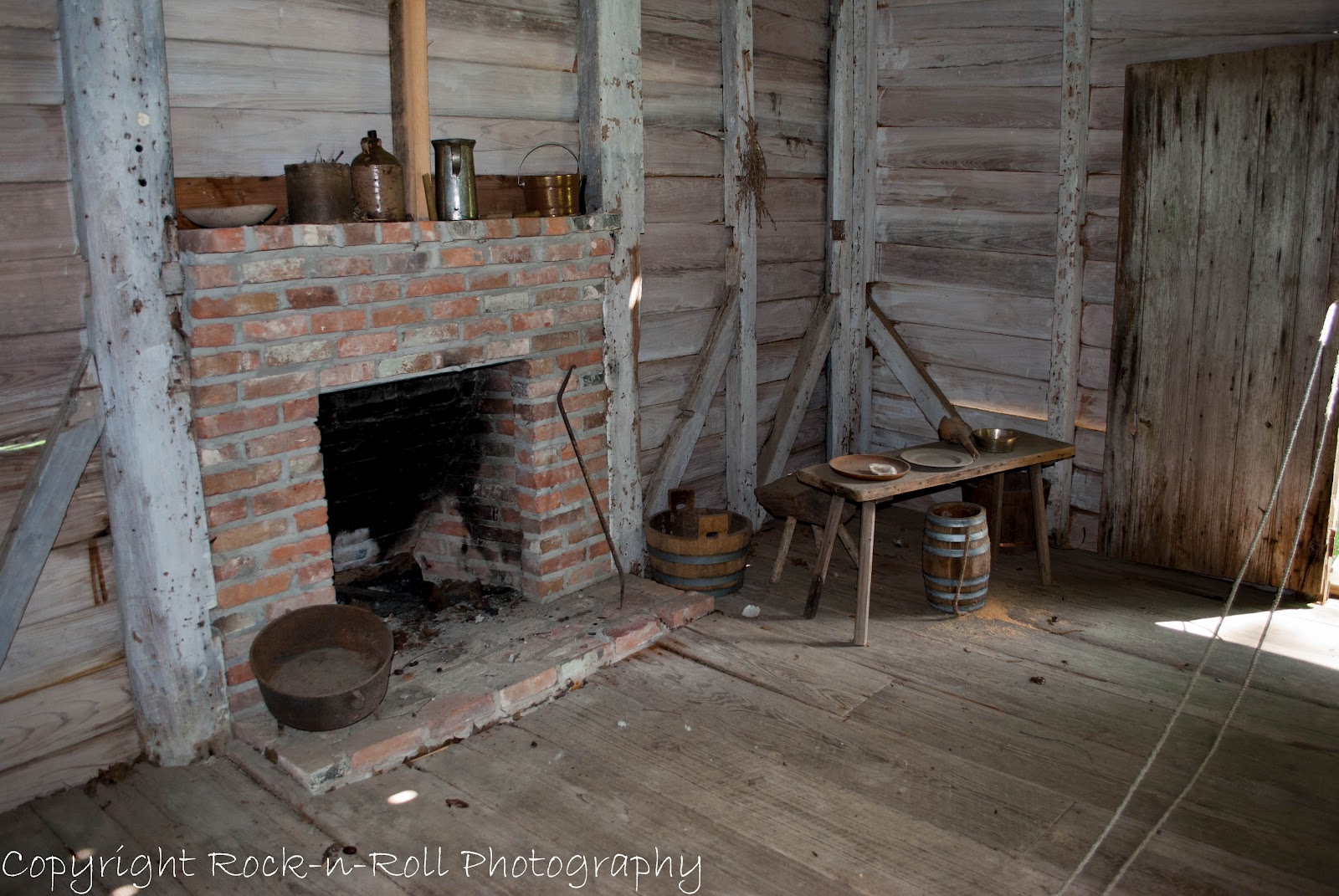
If you've never seen the inside of a
slave cabin, this is one half of the
cabin. I've seen several as we've
traveled all over the south and there
are many slave cabins that are still
standing. They all look like this.
Very little possessions. Very crude.

The other half of the slave cabin. Where meals were cooked,
eaten, and the slaves actually lived. Also during the hot
months the slaves slept outside for the same reason the
owners slept outside. Looking for cool breezes.

A close up of the slave cabin.
It measured approximately 12x12
square. So about 144 sq ft for all
of your living. Sometimes the cabins
even held more than one family so as
to cut the costs to the owners for
providing housing. 

One of the wagons that had been left on the property when
the state bought it.

The original barn for the property.

This explains the purpose of the picture next to it. Basically
it's a greenhouse that was sunk into the ground by about 10
or more feet to maintain a constant temperature. The plantation
owners liked to grow exotic fruit such as pineapples so show
off their wealth.
This is the top of the "Pit" which was
the green house for the property.
On one side was a 5 ft deep brick
enclosed compost pile and on the other
were the steps to descend. As the
compost decomposed, it would
generate heat. Keeping the Pit warm
in the winter. The windows could be
opened in hot months to allow for
air circulation for the plants.

The entrance to the formal and kitchen
gardens for the house exactly the way
they were layed out originally.

One of the apple trees in the kitchen garden.

This is a "shoo-fly." Most of the plantations had them. They
were in the dining room and a small young slave would be
stationed at the end of the rope. His job would be to slowly
pull the rope so the Shoo-Fly would move gently back & forth
creating a slight breeze to keep the flies away from the food
and the family & guests cool. They used this as all the doors
and windows would be open to catch breezes in hot months.

The china hutch for the house which
held three generations of china for the
family. The pewter was the oldest set.

The house was equipped with a safe in the office
for safekeeping all the important papers, bills,
and any money. It was built into the wall had a
door frame around it and a wooden door with
a small lock that the owner would keep with them.

The original candle light fixture for the
house. These stairs were originally
outside the house on the gallery.
Anytime you had to go up or down
you had to go outside, later the house
was remodeled and part of the gallery
enclosed along with the stairs.

A baby crib equipped with mosquito netting.

This is a small circa 1810 cradle made
of walnut probably by a skilled
slave. In the south most skilled labor
was also slave labor. I loved the
simplicity and look of it. The slave
who tended the children would sit
up all night and rock the baby in it.
They usually didn't get to sleep much
especially since there was no way
to put mosquito netting over it.


Sunday, June 3, 2012

Romeo, Romeo . . .

Fuzzy beauty
Shakespeare and beauty just go together. When you think of the plays and sonnets of the Bard, you are immediately struck by the way he used words, phrases and how much he knew about human nature. Now if you couple Shakespeare with a beautiful setting filled with flowers & flowering plants, green grass and some food & drink you might just have pretty close to perfect evening. 
Friday at the San Antonio Botanical Garden, we spent time having that kind of evening. It was Shakespeare in the Park night and the Magik Theater was doing Othello. The Gardens were lovely, the play was excellent and the company was funny, corny, witty and great! It was a dear friend (my kids consider her their adopted Grandmother), my children, the latest g.f. and me so of course I'm going to think the company was wonderful. What else can I say!
Down to the conservatory
I spent some time beforehand wandering from garden to garden taking pictures (naturally) and also found some of the crowd who were relaxing before the show to be interesting and photogenic.  
San Antonio's Shakespeare in the Park is usually the first week of June just as kids are getting out of school. A nice way to start the summer with the family. The performance runs for several days and is always well attended.
The Botanical Gardens were in good form this year thanks to much needed rain, and careful tending of plants by the staff. Gates opened at 6:30 and there were food & drink booths, a T-shirt booth and booths for information on the Gardens event calendar and the Magik Theater. The Garden was also lit for the evening, making the event more than magical, they were romantic and exotic also.
Most large cities do some kind of Shakespeare in the Park, often times for free as was this one. If you get a chance to see this type of event, I would highly recommend it. As for the SABG, they have more on tap in their event calendar. All through June, there will be a concert series presented for lovers of classical music that is reasonably priced and having attended in the past, I can vouch for it being worth the small price of admission. A few caveats for attending this type of outdoor venue performance. 
1) take bug spray or some other similar kind of bug repellent; as the mosquitoes in San Antonio can be vicious this year;
2) take either blankets, beach towels or folding chairs so you have a place to sit. Seating isn't provided. We brought both a blanket and chairs. Seating at the SABG was spilt between blanket areas and chair areas so that everyone could see;
Another photographer who was enjoying the gardens and
relaxing before the play began. He was smart and cute. And
Danielle was no where around so I could shove them together.
Just my luck.
3) come early as parking can get difficult to find as there are large numbers of attendees and the earlier you come the better seating you'll find.


Miss Alice, I love you!

My beautiful baby girl. 

T-shirt selling

Just thought these were lovely

This is a close up of the previous. And up close they look like
little trumpets smeared with hot pink lipstick.

I love orchids, and some day I gonna have me a greenhouse
just filled with them. :)

So delicate and so beautiful

It was screaming at me, "Take me home!"

Bromiliads galore

The fountains were on, thanks to the
rain.

Bocce anyone?

I talked to this sweet volunteer for a while. What a nice lady
she was with a fun personality who made me laugh.

I have one of these in my yard, we call it the "feed me" plant
because the blooms are so large they look like something out
of a "B" horror movie that would eat you if you got too close.

A Rose by any other name . . .

Lovely water lily, with drops of water on its petals.

Poor little Dove was thirsty.


Aren't these gorgeous with all the varying shades of red, pink
and white? I thought so.

Just relaxin'

Where's the tequila to go with these limes?

I would love a tree like this.

A close up of the flower

Donations anyone?

I was reading till .  .  .

My handsome, smart and oh so humble son
along with his current g.f. Carli. 

I want a hat like this to chill with